

SAVOURING
/
To experience something slowly over time, in order to find deep satisfaction and pleasure in it, is to savour it. We linger, connect, sense, and feel, allowing the qualities of the experience to take up space within us. Through the act of slowing down and opening to the experience, we come to know and feel more deeply the gifts being offered in that moment.
Art-making benefits from this experience of savouring. The more willing we are to spend meaningful time with our work, the more we receive—it fosters a deeper understanding of ourselves, which we can then bring to the vision we hold for our creative work.
I consider art-making to be a relationship, both to the self and to the work. Like all relationships, it requires commitment and attention. We need to nurture that relationship and sustain the connection over time, through all the inevitable changes that may come. What supports us in doing this is returning, again and again, to why this relationship matters, and savouring its beauty and its capacity to expand our experience and understanding.
So often we are swept up in getting somewhere—to an outcome, a result, a place of more ease. In doing so, we don’t always allow ourselves the grace of lingering, or of doing something for the pure joy of the experience itself.
We have so much pulling at our attention now, asking us to quickly shift from one thing to another. We skim and scroll, stop and start, lose focus, and then claw our way back to what we actually want—and need—to be doing. It’s exhausting. We are yanked around by the sheer volume of what is available, intoxicated by the endless options for our attention. Like many of you, I question how this serves us—or our art. In many ways, it feels counterproductive.
If we can’t slow down enough to reflect on our lives and our creative work, how can we know what is true for us, and what we want to express through our creative voice?
I am old enough to have lived a good portion of my life in the analogue world—the time before smartphones, the internet, and AI. Over the years, as I have adapted to the ever-increasing pace of our world, I’ve noticed that I need to be more intentional about savouring. It is something I must consciously make time for, and offer to myself.
Even when I do slow down and tune into myself and my work, my mind wants to leap back into the stimulation and noise I am trying to step away from. The dopamine hit calls, and I am faced with a choice. Do I stay with the discomfort rising within me, allowing for more inner spaciousness? Or do I give in to the momentary relief that stimulation offers, abandoning the deeper need trying to emerge?
This struggle is very real. When normal creative anxiety shape-shifts into full-blown resistance, any distraction becomes difficult to resist. We want relief, not the discomfort of staying with what we feel.
But art-making inevitably brings discomfort—it is part of the nature of creative work. So we must find ways to connect with something that feels meaningful enough to stay. To remain in the discomfort long enough to begin, and to continue even when we feel uncertain about the process or the outcome. We also want to move thoughtfully in our work, rather than impulsively in response to the discomfort that may be brewing.
Savouring is directly tied to discovering the deeper, meaningful qualities of what art-making offers us. These are revealed when we allow time and presence to do their work.
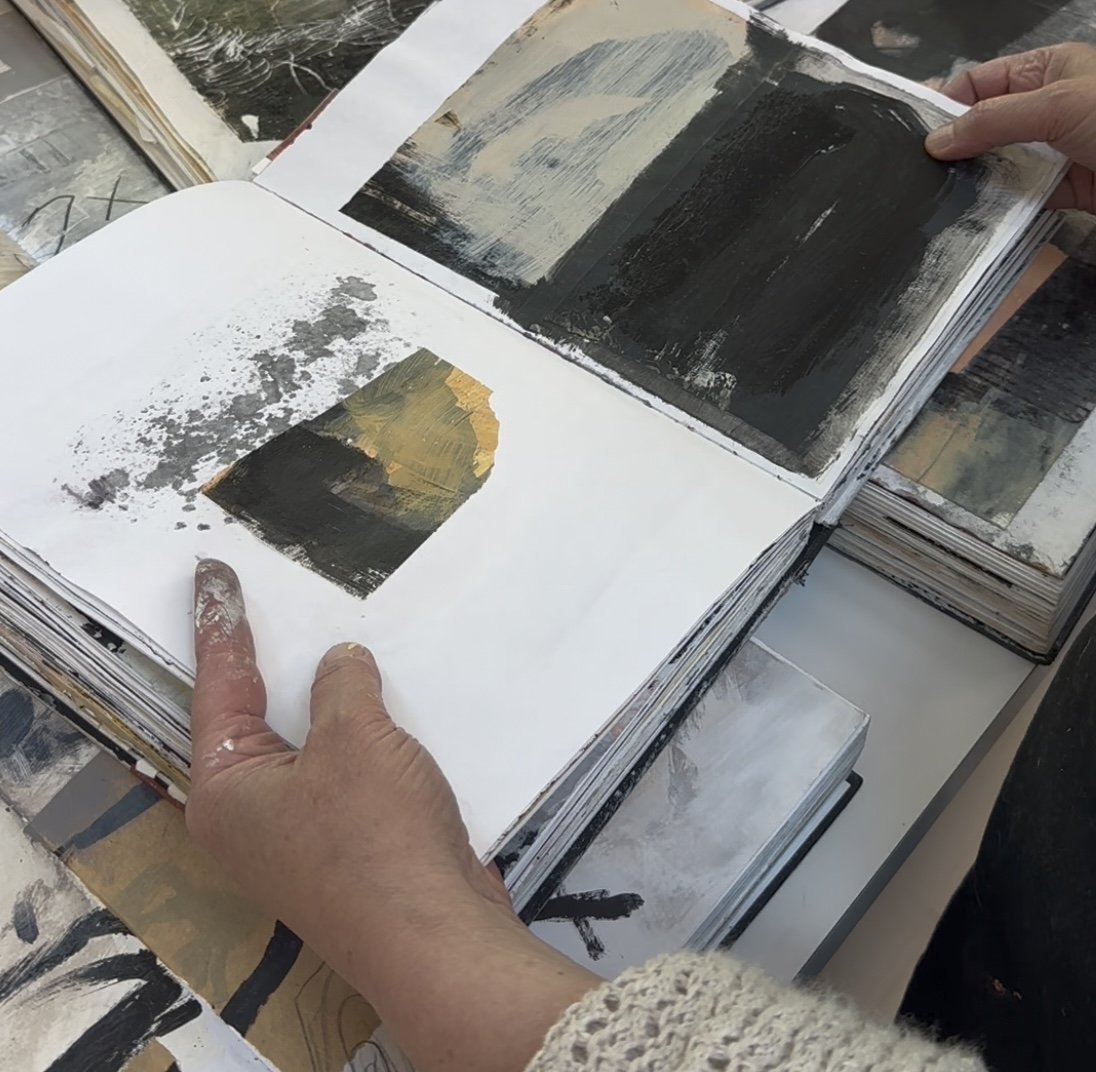
Many of us have experienced looking at a piece of art long enough for more to reveal itself. Or listening to a piece of music repeatedly, coming to know it more deeply. This is savouring. The more time we spend with a work of art, the more we receive from it. Imagine what might unfold if we extended that same attention to our own work, and to the process that shapes it.
Savouring is a practice of tuning out the noise—the thoughts, the distractions, the impulse to leave when uncertainty arises—and dropping into a deeper way of seeing and feeling.
What supports this is awareness of our thoughts, intention in our choices, and curiosity about what is already present for us to engage with. It also asks for a commitment to a process that explores our work without immediately jumping to outcomes or usefulness, and instead moves toward a deeper relationship with the work itself.
We can begin by noticing outcome-driven thoughts like, “Is it good? Will anyone like this?” or “Will it sell?”—and gently shifting toward more relational questions:
What is coming through the work? How am I reflected in it?
What feels new? What feels familiar? What excites me?
What part of my voice is strong here? What part is quieter?
Is there more for me to express? What is being revealed, and what might I be resisting?
If this painting has something for me, what might it be?
These questions foster a relational dialogue with our art, drawing us closer to presence and to the act of savouring. With practice, you may find yourself spending more time looking and reflecting than you typically would. In turn, the choices you make become more informed—rooted in a deeper awareness of what is there, and what matters to you as an artist. From that place, you can move forward with greater clarity.
Resistance has little foothold in this space of savouring, because curiosity softens judgment. You are freed once more to honour your art practice with the depth of regard it deserves—a gift beyond measure.
Prefer to listen? Click on the link below to listen to and/or download the audio version of this Blog post